Your growth manager now works to what you agreed
Agree once what a customer may cost and what it may do alone. Your growth manager handles the rest and writes only when a decision is yours.
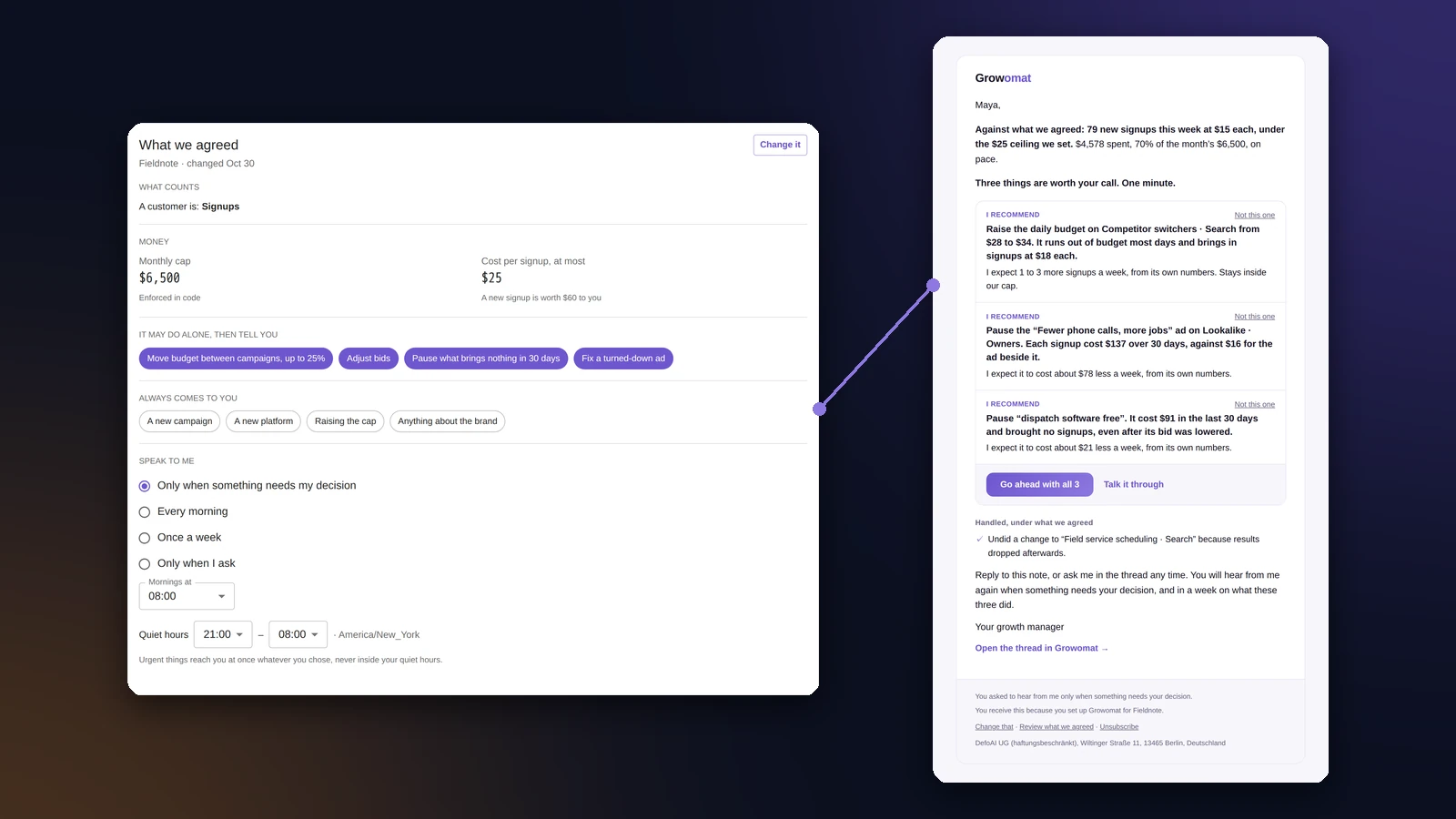
Running ads used to mean a list of chores: check the numbers, find what is wasting money, decide what to change, then go and change it. Your growth manager now takes the list. You agree once what a good result costs and what it may do without asking. It does the work, and it writes to you only when there is a decision that is yours to make.
A good manager doesn't ask you to approve every small thing. They know what you are after, what you can afford and where the line is. Then they get on with it and come to you with the few calls that need you.
That's how Growomat's growth manager works from today.
What we agreed
Every business in Growomat now has one screen called What we agreed. It's the brief your growth manager works to, and it fits on one page.
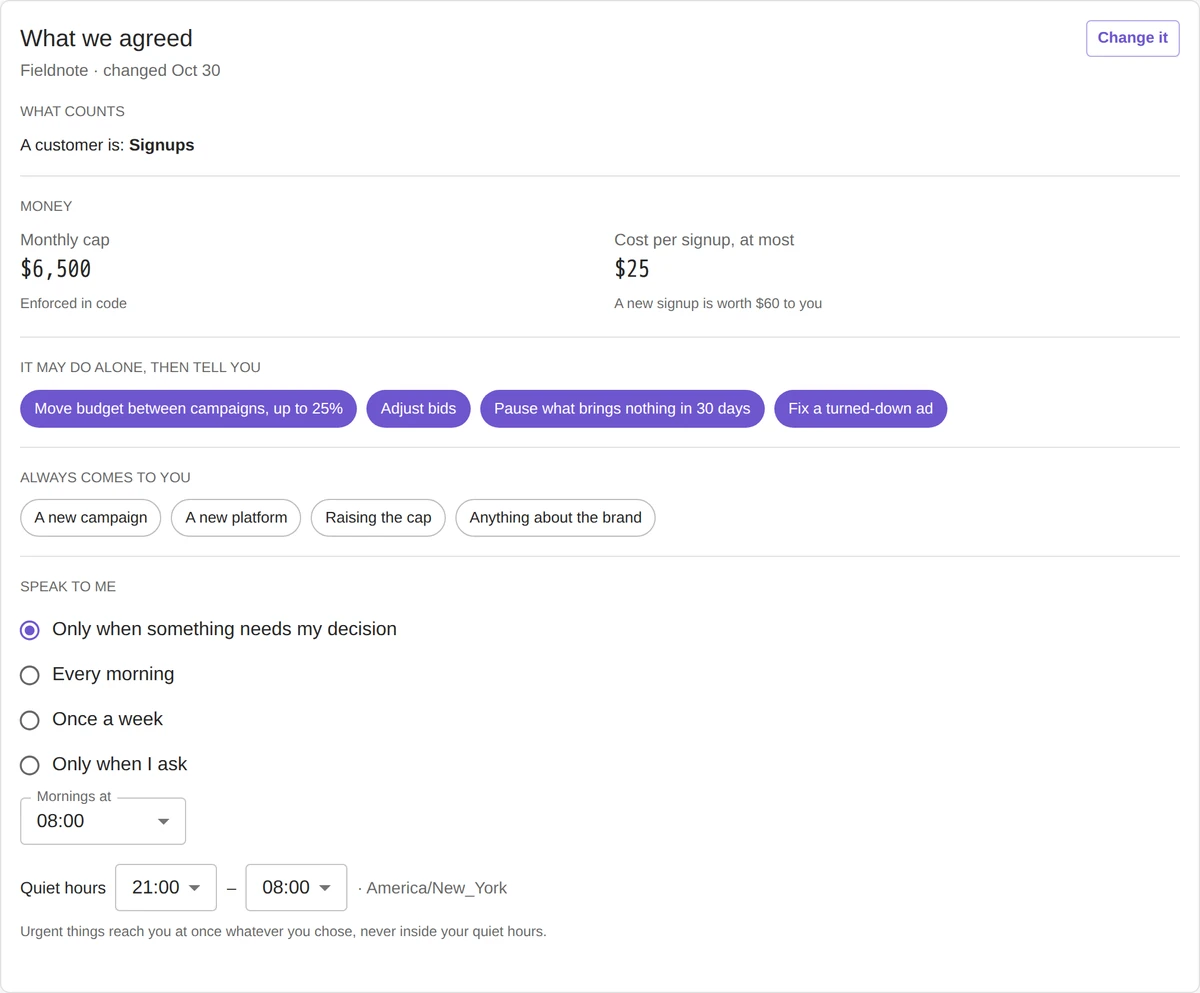
What counts. A customer, a booking, an enquiry, a sale or a signup. Every number it tells you is about that result, not clicks or impressions.
The money. Your monthly cap, and the most one result may cost. Both are enforced in code, not left to good intentions. While your cost per result is above the line you agreed, it won't raise a budget or a bid, and it won't recommend that you do either.
What it may do alone, then tell you. Move budget between campaigns, adjust bids, pause what has brought nothing in 30 days, and fix an ad a platform turned down. Turn any of them off and that kind of change comes to you as a recommendation instead.
What always comes to you. A new campaign, a new platform, raising the cap, and anything about your brand. These aren't switches. Your growth manager can't do them on its own, whatever is turned on.
When it speaks. More on that below.
Changing any of it takes one click, or one sentence in the thread: "Never go above $40 a booking" is remembered and kept to, with the date you said it.
It learns your business before it asks
You don't fill in a form on day one. After reading your ad accounts, your growth manager suggests the brief itself in its first note: what a result costs you today with a little headroom, the result that matches what you told it you want, and what it learned from reading your website. If it doesn't know what a customer is worth to you, it asks, and stops asking after a couple of tries.
You agree it or change it. Until you agree, nothing is held to a ceiling you never set.
A note, not a report
When there's something for you, your growth manager writes a note. By email and in the thread, with the same words in both places.
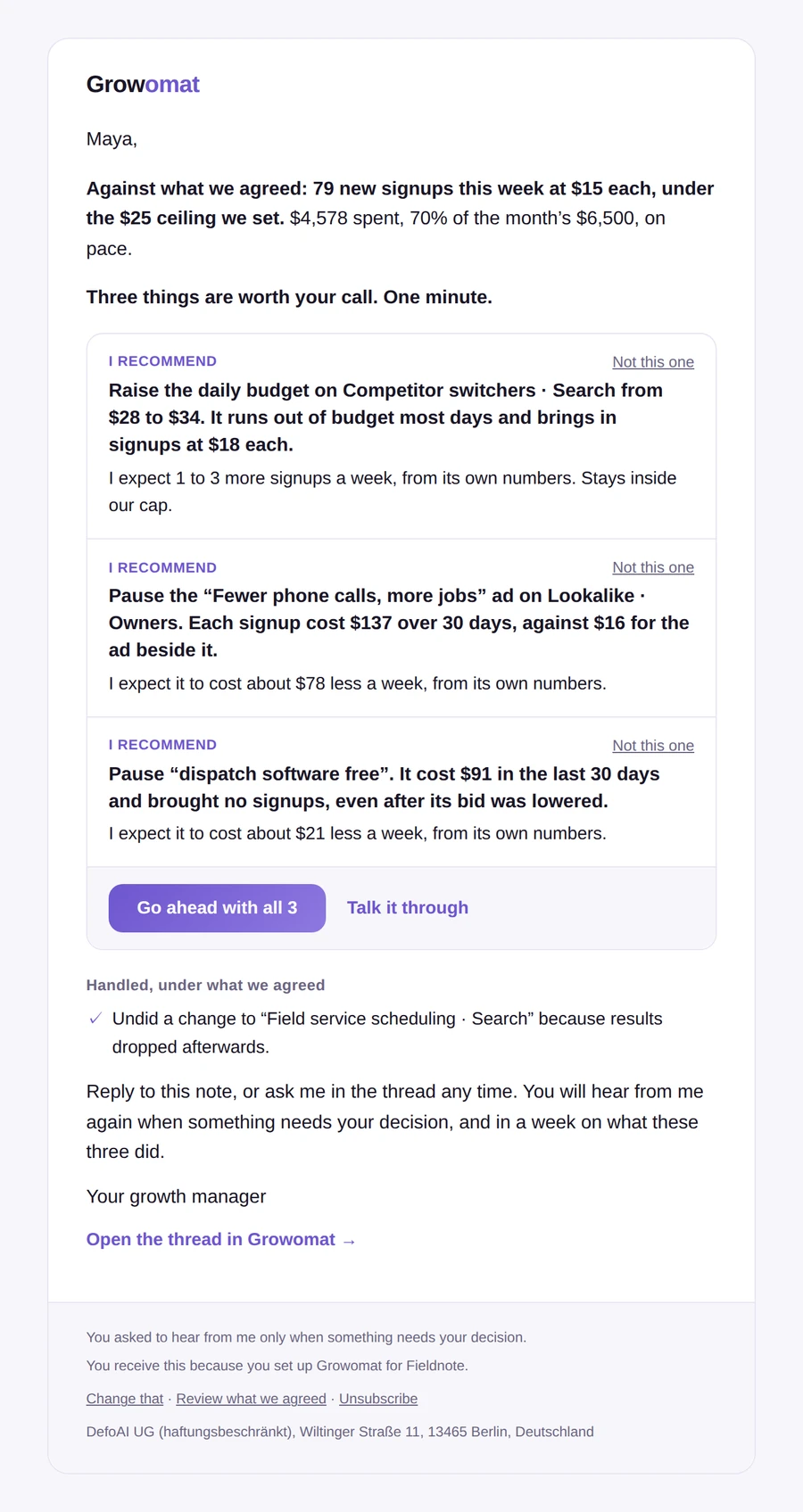
It opens with how you are doing against what you agreed. Then it brings at most three decisions, the ones with the most money at stake first. Each one says what it recommends, why, and what it expects to happen, worked out from your own numbers. Then one button: Go ahead. One click covers all of them, and it works straight from the email, without logging in.
Not keen on one? Choose Not this one and, if you like, say why in a line. Your growth manager remembers it and won't bring the same change back unless the numbers have moved a lot. Even then it asks only once more.
Below the decisions is what it handled under what you agreed, and what it's keeping an eye on. That's the part you can skim.
You choose how often
What we agreed has four choices:
- Only when something needs my decision. The default. No decision, no email. If a month goes by quietly, you get one short line to say all is well.
- Every morning.
- Once a week, on Monday.
- Only when I ask. No notes. At the start of each month it tells you in the thread how it did.
Whatever you choose, something urgent reaches you at once instead of waiting for the next note.
It owns the result
A recommendation is a promise, so your growth manager keeps score. Every change it recommends says what it expects. A week after you say go ahead, it checks: better than expected, as expected, or worse. The next note leads with the ones that went worse, before the good news.
On the first note of each month, it tells you how it did the month before, with the misses named.
Turned-down ads, fixed
When a platform turns down an ad and says which words it objected to, your growth manager takes those words out and leaves the rest of the ad as you wrote it. If fixing turned-down ads is one of the things it may do alone, it makes the fix and tells you. Otherwise, or if the ad is one you asked it to leave alone, the fix comes to you as a recommendation.
One place, and it remembers
Everything your growth manager does now lives in one place: the thread, with Waiting on you and What I changed on the Plan tab. And it remembers what you tell it. Say "don't touch the brand campaign" or "January is always quiet for us" once, and it keeps to it. Every change it suggests that leans on something you said tells you when you said it, and you can correct or remove anything it has learned.
What it does on its own, by plan
On Advisor, your growth manager recommends and you say go ahead. On Manager and Scale, you can let it do the things you agreed on its own, inside your cap and your ceiling. Every change it makes is listed in What I changed.
Acting on its own, your growth manager optimizes campaigns on all six platforms. Applying a platform's own recommendations is available on Google Ads and Microsoft Advertising only. Reddit Ads, LinkedIn Ads and ChatGPT Ads have no recommendations API, and Meta Ads is planned.
Why we built it this way
You shouldn't have to manage your manager. The old way asked you to read a report, decide what it meant, and do the work. Now the work is done and you make the calls.
Fewer, better decisions. Three at most, each with a reason and an expectation. If a decision doesn't need you, you won't hear about it.
The limits are real. Your cap and your ceiling are enforced in code, and the things that always come to you can't be switched off.
It answers for its calls. Every recommendation is checked a week later, and the misses come first.
See a whole note on the sample page, or read how it works on the growth manager page.
Run all four platforms from one place.
Build, optimize and report on Google, Microsoft, Reddit and Meta campaigns without an agency retainer.
See what it costsRead next
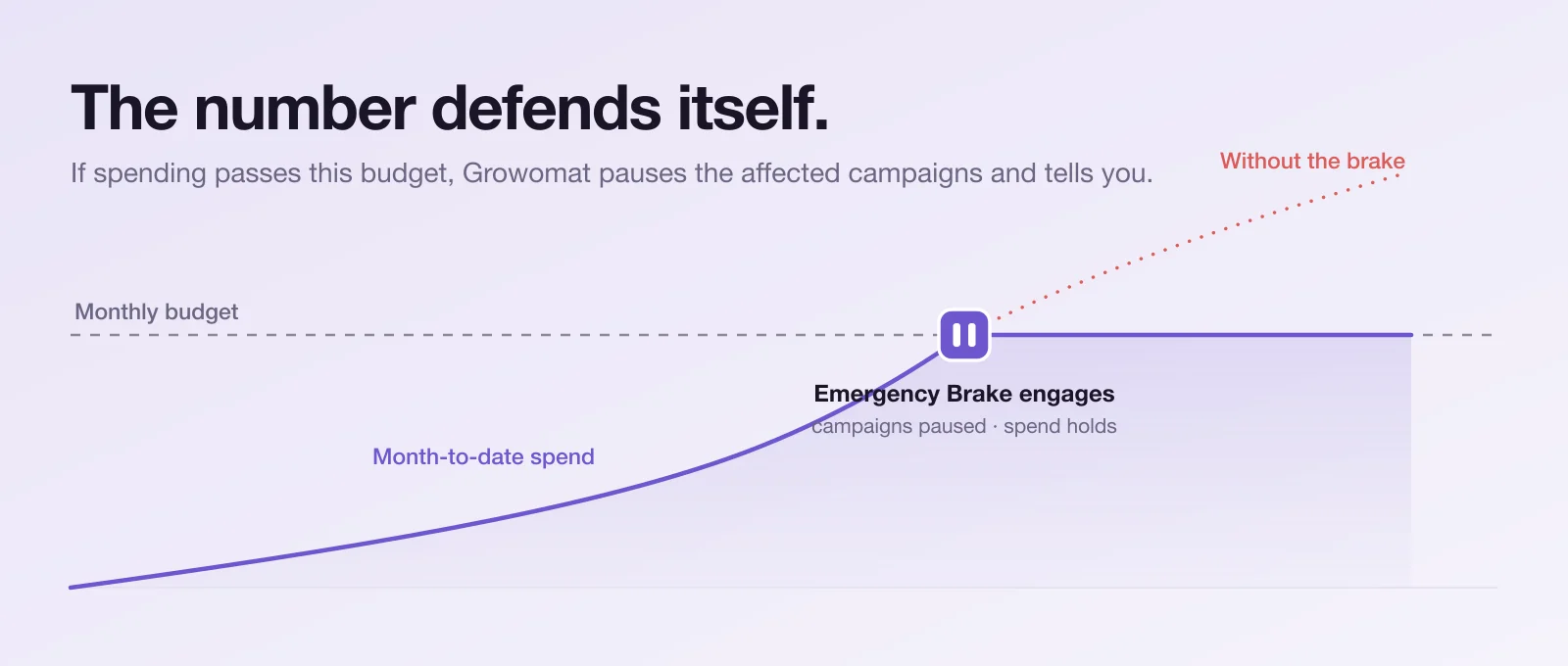
Your ad budget is a hope, not a guarantee
Every ads tool alerts you when spending passes your budget. None of them act on it. How the Emergency Brake pauses campaigns, and what it deliberately never does.

See what your competitors run, and where they beat you
Growomat now shows who you compete with for customers, what their ads are offering, and tells you when they change something that matters to you.