Your ad budget is a hope, not a guarantee
Every ads tool alerts you when spending passes your budget. None of them act on it. How the Emergency Brake pauses campaigns, and what it deliberately never does.
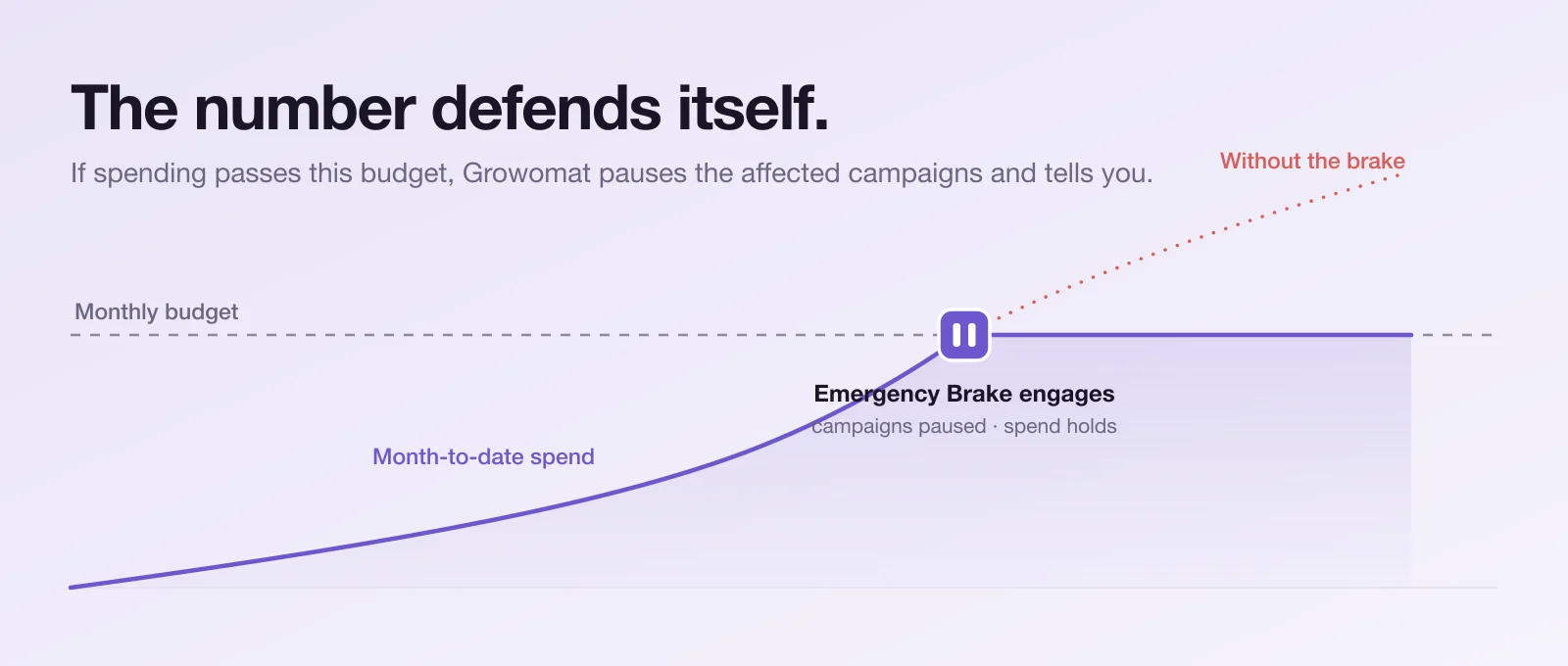
Here's an uncomfortable question we asked ourselves recently: what actually happens when your ad spending passes the budget you set?
We went looking through our own product for the answer, and it was the same answer every other ads tool gives. Nothing happens. You get an alert. A chart turns red. The campaigns keep serving.
Growomat already asked you for a monthly budget. It already knew, to the euro, when you blew past it. And at the moment real spend crossed the number you gave us, not one line of code reacted. We're not unusual in this — we couldn't find a competitor that does more than notify — but "everyone else also just watches" is not a defence we wanted to keep making.
Budget features come in three kinds
Once you sort budget tooling into three buckets, the gap is obvious.
Preventive features block a mistake before it happens. We had that: try to raise a campaign budget past your account cap and the edit is refused on the spot.
Advisory features compute a status and show it to you. We had plenty of that: pacing, month-end projections, threshold alerts.
Reactive features notice that actual spend has crossed the line and do something about it. We had none. Neither, as far as we can tell, does anyone else. Every overspend "protection" we surveyed is a notification — which means the budget is homework the tool assigns to you, at the exact moment the money is already going.
There's a structural reason this hole exists everywhere. Campaign budgets are daily amounts, and the platforms' own pacing legitimately overshoots them within a day, so "over budget" never feels like a crisp event — it feels like weather. Nobody's code owns the moment "spending crossed the user's number." So the number you typed into the budget box was a hope, not a guarantee.
That gap is the feature we just shipped.
The Emergency Brake
Its entire contract fits in one sentence, and the interface shows you exactly that sentence:
If spending passes this budget, Growomat pauses the affected campaigns and tells you.
It's on by default, and it attaches to every budget amount already in the product — you don't author a second number anywhere:
- Each campaign's budget. A daily budget already implies a monthly ceiling: the daily amount × 30.4, which is the same rule Google uses to define your charged monthly maximum. When a campaign's month-to-date spend passes its monthly equivalent, the brake pauses that campaign.
- Your account budget, as the backstop. When the whole account's month-to-date spend passes your monthly budget, the brake pauses every running campaign. Even if you've switched every campaign-level brake off, the account-level number holds. That backstop is what the feature is named for.
The pause itself is deliberately unremarkable. It goes through the same audited write path as an edit you'd make yourself — it shows up in the revision history with the brake as the actor, and it propagates to Google, Microsoft, Reddit and Meta exactly like any other status change.
"About every hour" is an honest sentence
A brake can never be fresher than the spend data behind it, so we wired detection into the moment fresh spend figures land from the platforms rather than into a separate timer — a faster timer would only re-read stale numbers with more machinery. On Pro accounts that means spending is checked about every hour; on trial accounts, up to daily. The ad platforms themselves also report spend with a short delay of their own.
We could have written "real-time" on the marketing page. It wouldn't be true on any plan, so it isn't written anywhere — the settings card tells you your account's actual cadence instead.
The same honesty applies one layer down. A chart is allowed to read a warmed cache; an action that pauses your campaigns is not. Brake decisions read only the store of verified daily spend facts, never a dashboard cache — a brake that could fire, or fail to fire, on stale convenience data isn't a brake.
What it deliberately never does
Most of the design work on this feature was restraint.
It never un-pauses anything silently. On the first of the month your spend resets and the brake re-arms — but the campaigns it paused stay paused, and you get a friendly note that they're ready to resume. Quietly re-enabling campaigns would spend your money without you, which is the exact thing this feature exists to prevent. Resuming is one click. It is always your click.
It never claims a pause you made. If a campaign was already paused when the brake fired, the brake doesn't touch it and doesn't record it. That's what makes release safe to press: it resumes exactly the campaigns the brake paused, and only those still paused — anything you've touched in between belongs to you again.
It doesn't flap. Each brake fires at most once per month, and the release flow leads with the choice that actually matters: raise the budget, and the brake re-arms against the new amount the same month — or resume anyway, and that brake stays disengaged until the month ends, because you've overruled the number knowingly.
It doesn't act on predictions. Projections stay advisory. The brake fires when real accrued spend passes the amount, not when a forecast says it might. Before it comes to that, you're warned — once, at 90% of the amount — that the brake exists and where it engages. It never surprises you.
It doesn't silently drop what it can't count. If some spend arrives in a different currency than your budget, it's counted conservatively and the mismatch is flagged in the brake status, rather than being filtered out of the sum. A protection with quiet exclusions is a hole shaped like a protection.
And it isn't an experiment. There's no rollout flag and no beta cohort. A budget that only sometimes defends itself is not a budget.
What it looks like when it fires
One notification, in-app and by email, that names the numbers:
Spending reached €512 of your €500 monthly budget, so the Emergency Brake paused your 7 active campaigns. Nothing else changes — release it whenever you're ready.
The campaigns list and the budget page both show a banner with the same numbers and the two actions — release, or raise the budget — and every row the brake paused carries a "Paused by Emergency Brake" pill. You can land anywhere near your campaigns and tell what happened, and why, without opening a single notification.
The controls live where the budgets live: the account-level brake on the budget settings page, the per-campaign toggle right beside each campaign's budget field. Turning one off restates, in plain words, what protection you're removing.
It's on the API too
Everything above is scriptable. The brake is part of the public API, the official SDKs, and the Growomat MCP connector:
get_budget        → amount, period, brake configuration
set_budget        → change the amount, or either brake level
get_brake_status  → armed or engaged, with the event and its numbers
release_brake     → resume exactly what the brake paused
If you already hold an API token with campaign scopes, you have all of this today — we put the brake under the scopes existing tokens already carry instead of minting a new scope nobody's token would include until they noticed. And with the Growomat connector, "did the brake fire this month, and why?" is a one-sentence question in Claude.
The worst case is "it stopped"
The point of giving a tool your budget is being able to think about something else. That only works if the number defends itself.
So this is the promise, and now it's mechanical rather than aspirational: a runaway campaign, a platform surprise, or a mid-month mistake can pause your spending — and that's all it can do. On Growomat the worst case is "it stopped, and here's why, and here's the button." It's never "it kept spending."
Run all four platforms from one place.
Build, optimize and report on Google, Microsoft, Reddit and Meta campaigns without an agency retainer.
See what it costsRead next
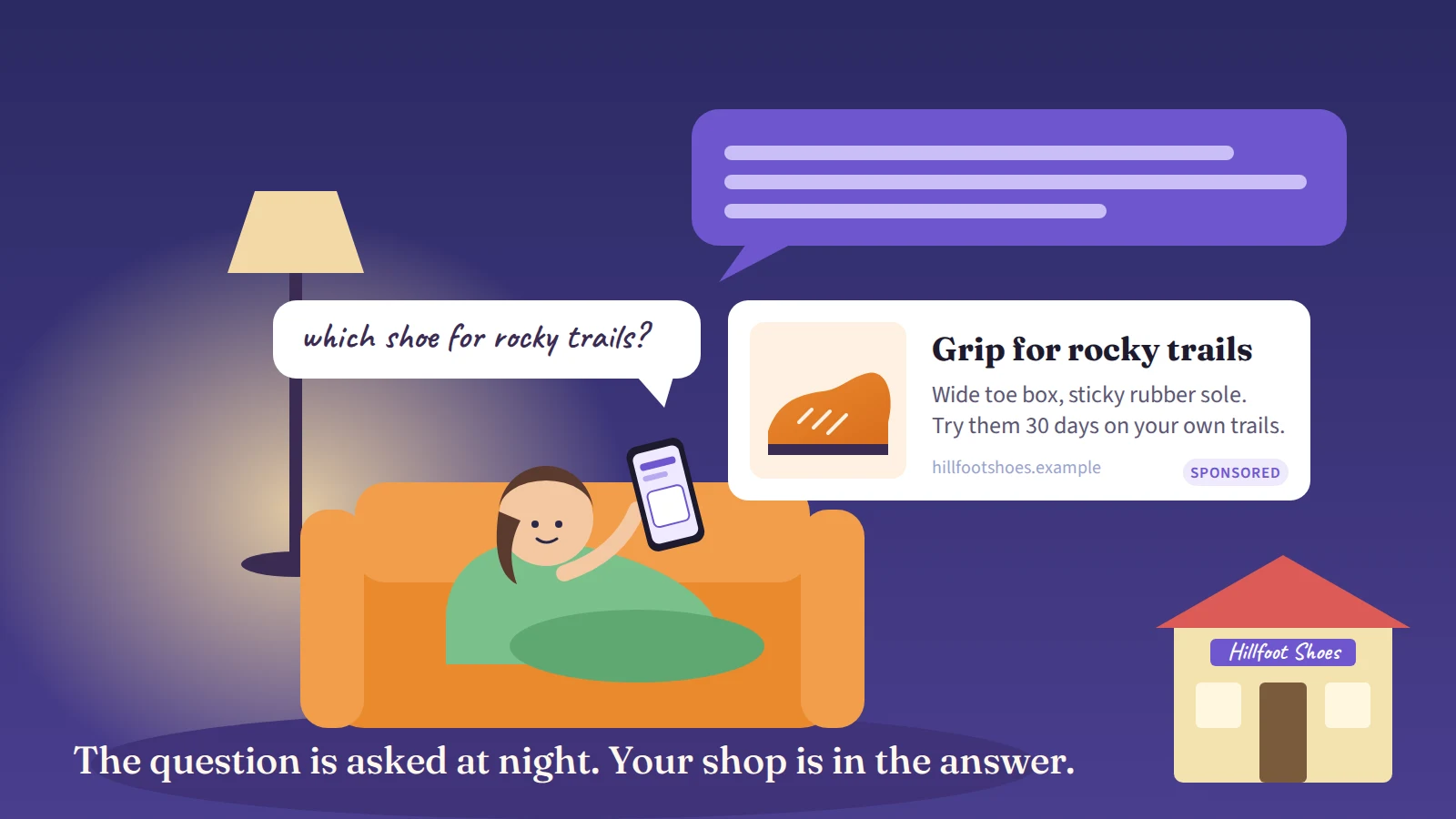
Your ads, inside ChatGPT answers
Growomat now builds, runs and reports on ChatGPT Ads beside your Google, Microsoft, Reddit and Meta campaigns. What a chat card needs, and what stays in your hands.
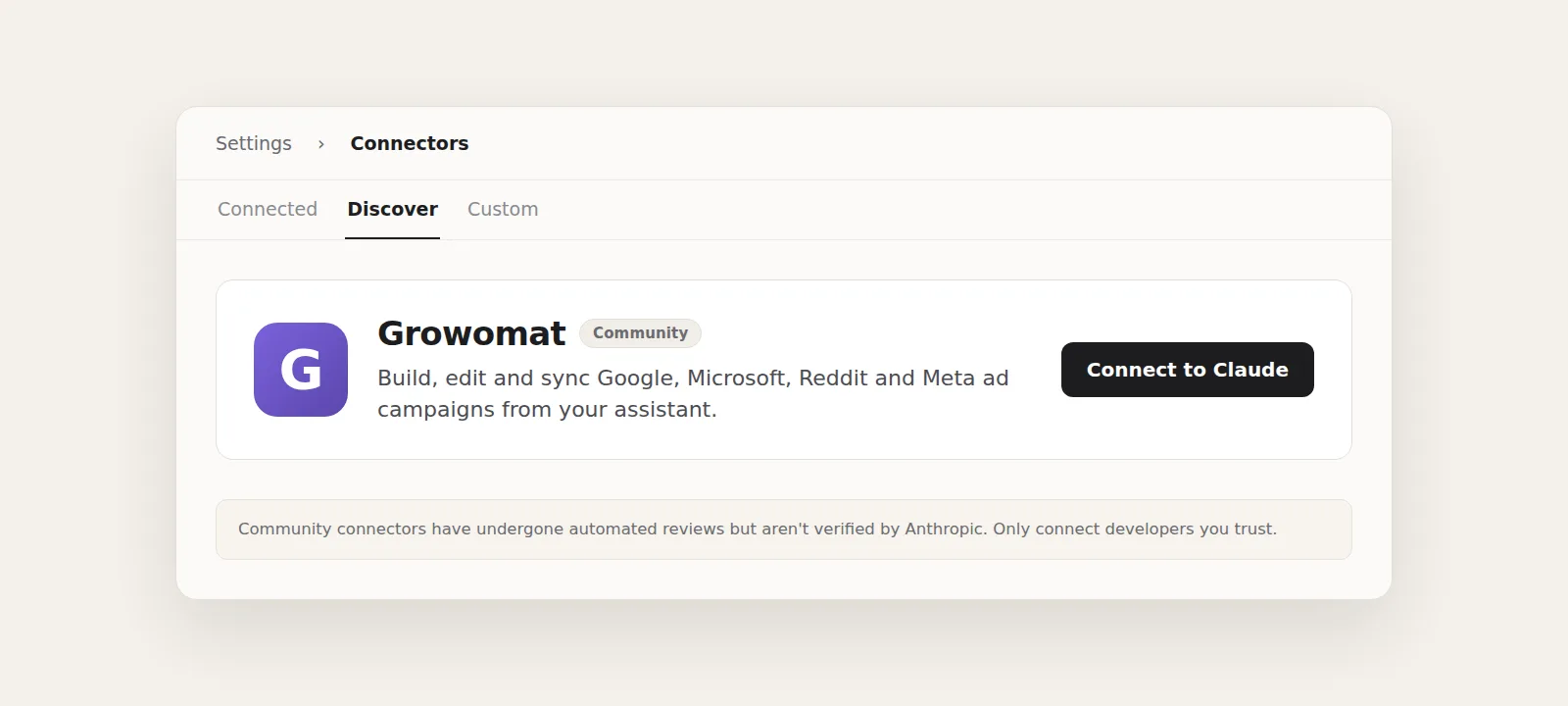
Your ads, one click away in Claude
Growomat is in the Claude connectors directory, so connecting takes one click. What you can ask for once it is connected, and what it will never do without you.