Your ads changed last week. Did you say yes?
Google, Microsoft, Reddit and Meta each switched something on in live campaigns this autumn, by default. What changed, where to opt out, and what we do instead.
Between the start of September and the end of October, each of the four platforms Growomat runs changed something inside advertisers' running campaigns without being asked. Most of the changes arrived as an email with an opt-out link and a date. If you missed the email, the change happened.
A new feature used to be a box you ticked. This autumn it is a box you have to untick, and the deadline is in a message you may not have opened. Here is each change, with the platform's own wording where we could get it, where the switch is, and what a tool that works for you should do about it.
Google put your coupons in your ads
From 12 October, Google Ads began reading promotions off advertisers' websites and inserting them into Search and Performance Max campaigns. Google's notice, reported by Search Engine Roundtable, says it "will automatically identify and extract high-quality promotions, such as coupons and deals, from your website" and "apply them directly to your campaigns", "without requiring any manual setup on your part".
It applies to campaigns with a linked location that do not already carry a promotion asset. It is on unless you turn it off, and the switch is at account level: Automated assets, then Automated promotions, then Off. There is no per-campaign version.
The problem is the word "high-quality". Nobody at Google has read your website. A discount that ended in August and still sits on a page you forgot about, a trade-only price, a code that was meant for a newsletter: any of them can become a promise in an ad, with your name on it, and the visitor finds out at the checkout that it does not apply.
This followed a larger move in September, when Search campaigns using campaign-level broad match or automatically created assets were migrated into Google's automated Search mode. The only way to stay out was to switch those settings off before the month began. Dynamic Search Ads follow in February 2027.
In fairness, the same week brought the opposite kind of change. Channel prioritisation, launched on 14 October, lets you mark Search, Shopping, Performance Max and Demand Gen as high or low priority for budget. That is a control handed back. One kind of change needed an opt-out. The other needed an opt-in.
Meta's tap no longer has to reach your website
On 28 October Meta switches on "product browsing" in ads that are already running on Facebook and Instagram. The notice, which PPC Land published because Meta has put nothing in its Help Centre or newsroom, says: "Starting October 28, 2026, we'll add product browsing to your existing ads." When someone taps the ad they "may see an experience on Facebook or Instagram with product info and personalized suggestions". That page is on Meta, before your website.
The evidence offered is one sentence and a footnote: businesses saw "3% more conversions" on average, in an experiment run from 6 to 21 August across about 117,700 advertisers. The footnote does not say what counted as a conversion, what happened to cost, or whether those conversions happened on the advertiser's website or inside Meta's apps.
That last gap matters more than the number. A visitor who browses your products inside Instagram and buys there, or leaves there, never loaded your page. Your analytics saw nothing. Your own tracking saw nothing. Meta saw everything, and reports it. If you have read why your conversion numbers disagree, you know where that ends: a report that only one party can check.
There are two ways out. The "Opt out" button in the notice works until 28 October, and the notice does not say whether it covers one ad account or all of yours. The per-ad toggle, under Advantage+ creative and destination settings, works at any time, one ad at a time.
From 30 October, what Meta's systems do is on you
Meta's updated Self-Serve Ad Terms take effect on 30 October. The terms in force today already say the advertiser bears sole responsibility for ad content, targeting decisions and placements. Reports of the new text, including Common Thread Collective's, say that responsibility now extends to changes made by Meta's own automated systems, including creative Meta generated and targeting or placements Meta chose. We have not been able to read the final wording, and Meta's page links to a preview. Read it before the date.
Put the two Meta changes together. On the 28th, Meta changes where your ad leads. On the 30th, whatever its systems change becomes your responsibility. And at Advertising Week, Meta showed a business assistant that builds campaigns and adjusts targeting and budgets from a chat. The coverage contains no sentence about whether you approve a change before it is made.
Microsoft removed the ceiling
From 1 October, new Microsoft Advertising campaigns on Target CPA, Target ROAS, Maximize Conversions, Maximize Conversion Value or Maximize Clicks can no longer carry a maximum cost per click. Microsoft's reason is that the cap "can interfere with its bidding system's ability to optimize toward performance goals", even when it is set above the campaign's average click price.
Microsoft is not wrong about that. A ceiling and a bidder that is told to hit a target will fight, and the ceiling usually loses something. But the ceiling was the one per-click promise a small advertiser could make to themselves, and nothing replaces it. Campaigns created before 1 October keep theirs. Portfolio bid strategies keep the option. Everything new runs on trust.
Reddit asked first
Reddit's Max campaigns, which hand targeting, creative selection, placements and budget allocation to the platform, have been open to every advertiser since September, and on 6 October they were extended to lead generation. Reddit's own figures are 17 percent lower costs and 27 percent more conversions than its regular campaigns, measured by Reddit.
The difference from the other three is the direction of the switch. Max is a campaign type you choose. Nothing you already run was moved into it. We note it here because it is the same offer, more automation in exchange for fewer decisions, and because the offer is now standard on all four platforms. The difference is who moves first.
What the four have in common
Each change lives in a different console, behind a different setting, with a different deadline. Each one arrived with a lift figure the platform measured itself, in a metric the platform defines. And each one lands the result on the advertiser: the promise in the ad, the sale that happened somewhere you cannot see, the click that cost more than you would have paid.
None of this is malice. A platform optimises for the number it can see, which is spend and its own count of conversions. It will keep reaching further into the account, because every time it does, that number goes up. The question for a small business is simpler than the features: who is watching the account on your behalf, and what are they allowed to do?
The opt-out list
Here it is in one place, because it is not in one place anywhere else.
- Google, Automated promotions. On since 12 October. Account level: Automated assets, then Automated promotions, then Off. Check what is on your website that looks like an offer, because that is what gets extracted.
- Google, Search migrations. Broad-match and auto-asset Search campaigns moved in September. Dynamic Search Ads move in February 2027. Each feature can be switched off again inside the migrated campaign.
- Meta, product browsing. On from 28 October. The notice's button before the date, scope unstated. The per-ad toggle under Advantage+ creative and destination, any time.
- Meta, new ad terms. In force from 30 October. Read the preview linked from the terms page. There is no opt-out. Read it anyway.
- Microsoft, bid ceiling. Gone for new standalone campaigns since 1 October. Existing campaigns keep it. A portfolio bid strategy still accepts one.
- Reddit, Max campaigns. Opt-in. The regular campaign types are still there.
What we do instead
Those switches live in the platforms' own consoles, and the list above is where they are. Growomat does not reach into your Google or Meta account settings and flip them for you. What it does is make sure the rest of the account behaves the way the list is trying to make it behave.
A campaign reaches the platform paused. The push lands paused on Google Ads, Microsoft Advertising, Reddit Ads and Meta Ads alike, and enabling it is a separate click. Yours.
Every change has a name on it. Whether you made it, Autopilot made it, or the Emergency Brake made it, the change sits in the revision history with its actor and goes to the platform through the same audited path. There is no category of change that happens and is not written down.
Autopilot is opt-in, and its limits are numbers you typed. It does nothing until you turn it on, and in recommend mode it only proposes. When you let it apply changes, every one is checked against your monthly cap, your daily cap, the swing you allow per day and a ceiling on any bid it sets. A change outside those limits is refused, not applied with a note. It will never pause the last running ad in a group. Where a platform has removed its own ceiling, the one on Autopilot's bids is still yours.
A campaign that appears or disappears on the platform side is a notification. Every fifteen minutes Growomat compares what it holds with what each platform holds. A campaign on the platform that Growomat did not create, or one that has gone missing, shows up as a message to you, not as a line on next month's invoice.
Conversions are counted from your sales, not from the platform's report. That is the whole of the conversion numbers post, and it is the only answer we have to a tap that no longer has to reach your website. If product browsing lifts your sales, your own number will say so. If it only lifts Meta's number, your own number will say that too.
The budget acts on its own behalf. When real spending passes the budget you set, the Emergency Brake pauses the campaigns and tells you. A platform that changes how it bids cannot change that.
Some of the changes above will help some advertisers. Take the ones that help you, when you have decided they do. A default is a decision somebody else made, with a deadline they chose. On Growomat, nothing goes live until you say so.
Growomat Product Team
Run all four platforms from one place.
Build, optimize and report on Google, Microsoft, Reddit and Meta campaigns without an agency retainer.
See what it costsRead next
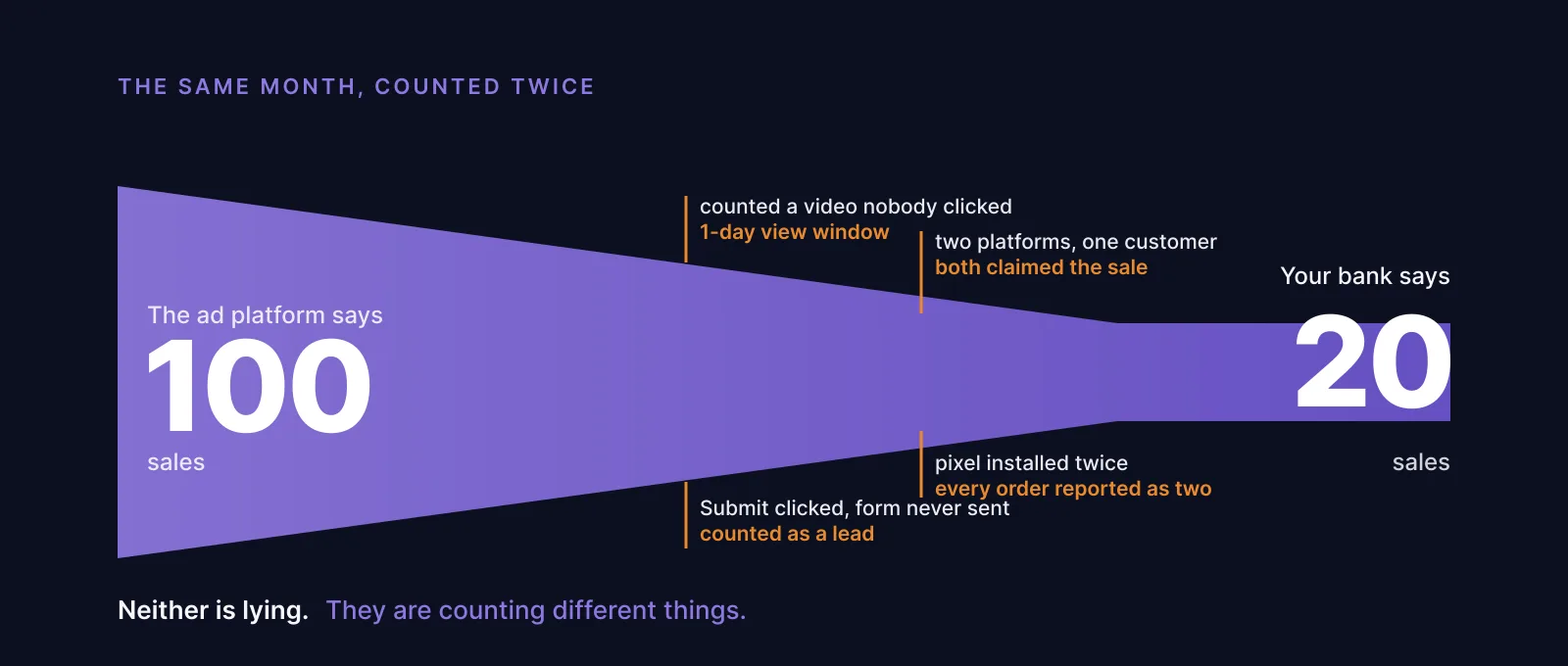
The ad platform says 100 sales. Your bank says 20.
Ad platforms, analytics and your bank never agree on how many sales your ads made. Why each counts something different, and how we built a number you can check.
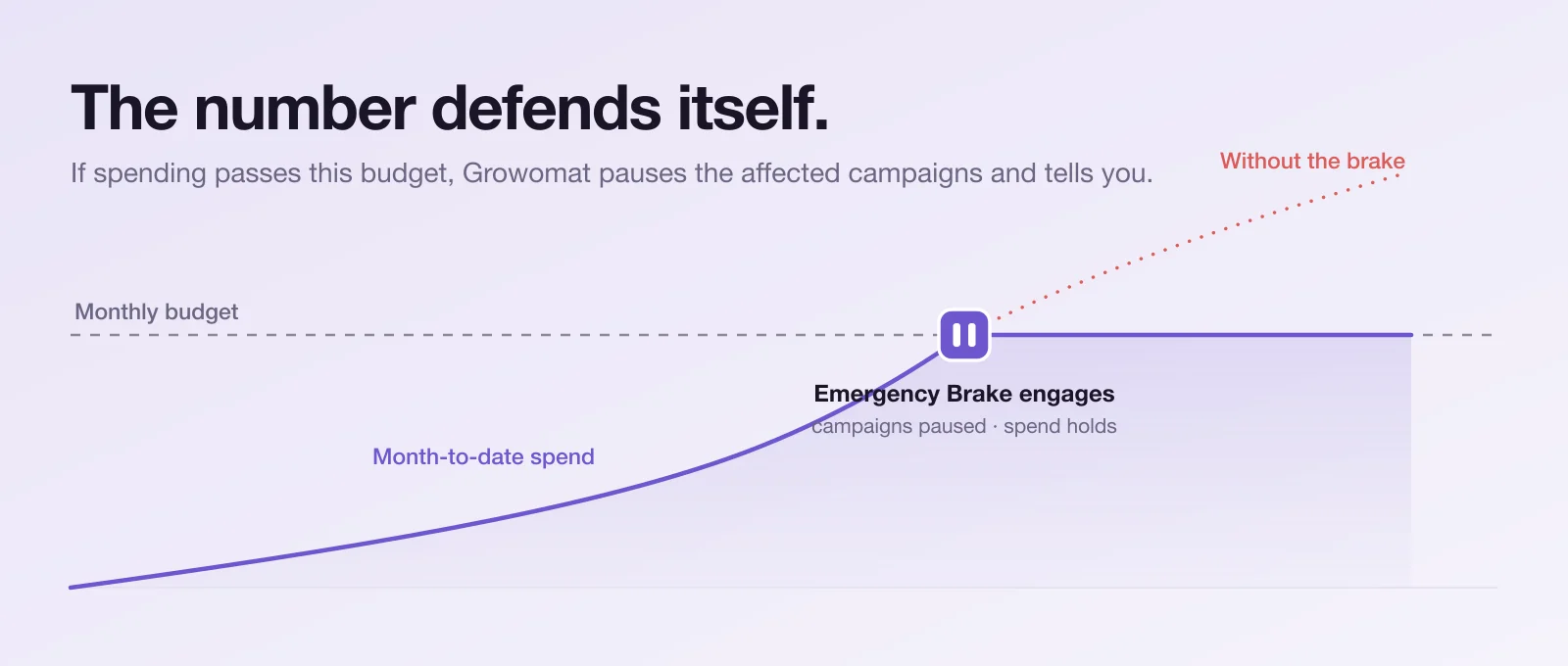
Your ad budget is a hope, not a guarantee
Every ads tool alerts you when spending passes your budget. None of them act on it. How the Emergency Brake pauses campaigns, and what it deliberately never does.